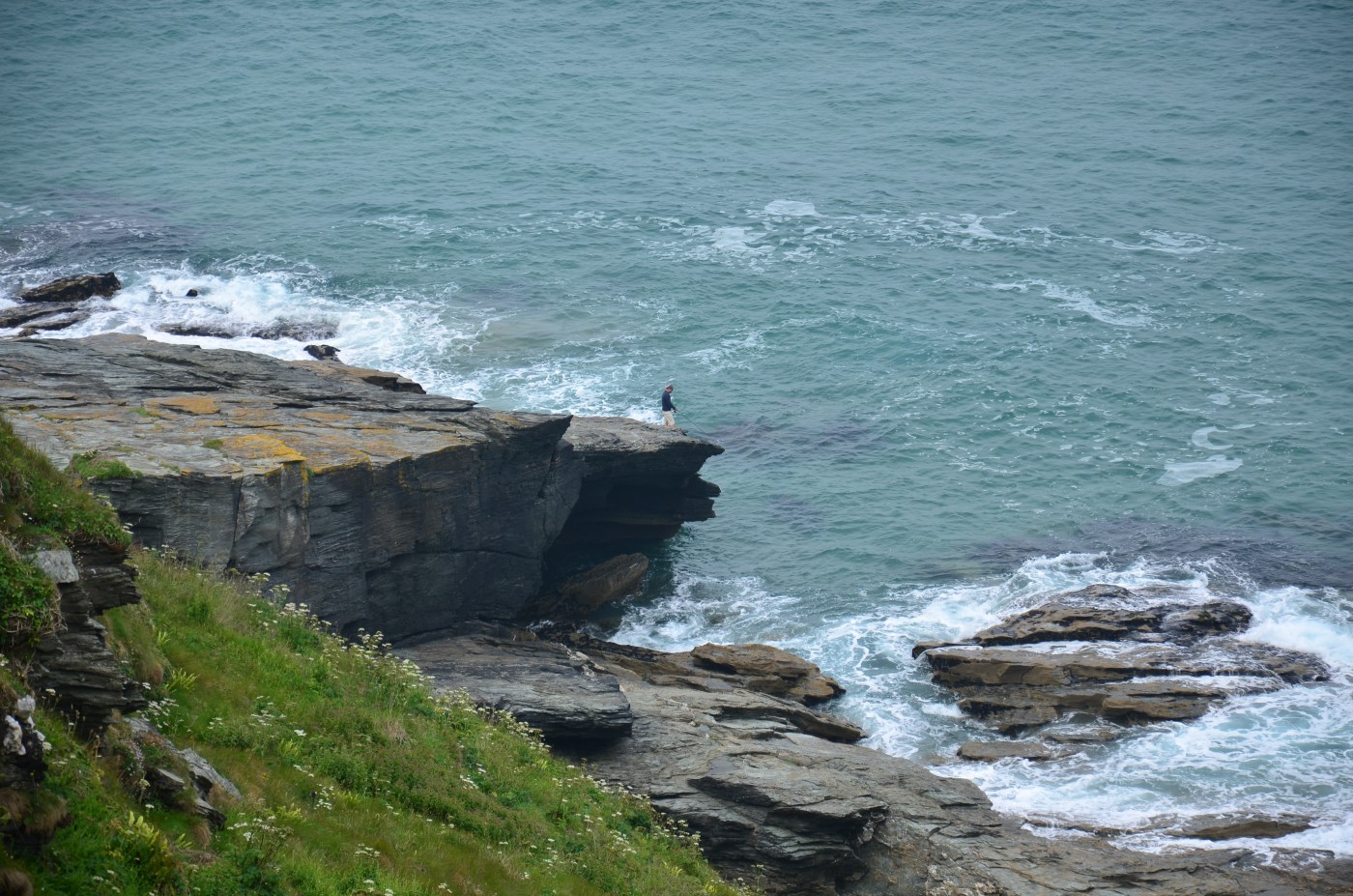
They mainly come at sundown. They emerge from the shadows of twilight, along with the roe deer and foxes. But while the animals wander quietly over the moors, stopping every few steps to graze or to look around, they set sail directly for the Solitary Man, a massive rock that rises like a peninsula from the Atlantic Ocean, surrounded by waves that crash on the jagged fingers of the mainland.
John doesn’t know what draws them to this place. Cornwall’s coastline has countless rock formations and sheer cliffs. So why this one? Does it have to do with its name, which some say can be traced back to the Celts?
Over the years, John has developed an instinct that alerts him when someone is coming, urging him to look out the window and watch over the heathlands like a faithful guard. He recognizes them from afar, by their way of walking, which unmistakably distinguishes them from recreationalists. They head straight to their goal, determined yet slowly. As if something in their bodies or minds still resists.
It takes John no more than a few minutes to put on his shoes and coat and climb the natural stone stairs that lead from his cottage to the top of the Solitary Man. He waits for them to walk to the edge and approaches them quietly but decisively. The timing is crucial.
They usually don’t notice him until he’s standing next to them. Their eyes are fixed on the waves. Some are still hesitating. Within others the decision is as solid as the rock on which they want to carry it out. He senses this flawlessly. The doubters are easy to persuade. As soon as John addresses them, he sees shame and hesitation taking over. The second type is more difficult to reach. They seem far away, even when they’re standing within arm’s reach.. As if they were already hovering somewhere halfway between the land of the living and the realms of the dead. However, John can always convince them to step away from the edge. Then he stands next to them, so they can talk. Because they all do.
In the summer, there are more of them. He’s always found that weird. You’d think the dark months would make people gloomy, but the Solitary Man is most popular on the longest days of the year. So often John stands on the rock on endless summer nights, listening to people whose faces are imprinted into his memory like his father’s cigarettes burned into the skin of his upper arms sixty years ago. John likes to rub his scars while listening to the stories the rock evokes.
Today, a foggy late November morning, John is sitting in his regular chair by the window when he notices a blue Ford Focus approaching on the semi-paved road. The car comes to a stop in the sandy driveway. Moments later, a young woman walks towards his door. It must be Kim Wakefield, a journalist from Penzance who called John last week to inform him that she’s writing an article about him.
He moved heaven and earth trying to convince her not to do so, but she said the article would be published anyway, with or without his cooperation. She had already spoken to some of the people he saved—her word, not his. So, wouldn’t he like to tell his side of the story? He didn’t say yes, but he didn’t say no neither, so she ended the conversation by saying she would come on Tuesday, at eleven o’clock sharp.
Now she stands before him with a broad smile. She’s a young woman with short, red hair and a trendy sweater. She greets him in Cornish, probably because she thinks that he, without a doubt a very old man in her eyes, will appreciate it. He switches to English as soon as they sit down at his round kitchen table.
After a few minutes, she ceases her attempts to keep going what John considers unnecessary small talk and pulls out a notebook. She places her smartphone next to John’s coffee mug. “I’m recording the conversation. Just for myself. So, John, it seems like you’ve saved a lot of lives already. Do you have any idea as to how many—”
“One hundred and eighty-seven.”
She looks up from her notebook abruptly. “That’s the exact number?”
“It is.”
“Do you keep track of it somehow?”
“I have a good memory. And meeting someone who is about to leave this life… Well, that’s something you don’t easily forget.”
They all linger in his mind, as they do—sometimes unwillingly—in this life.
“Are there similarities between the people you meet on the rock, like a recurring profile?”
“They are unique. Each and every one of them. Men, women. Young, old. The oldest was eighty-five. A man from Salisbury, who had come all the way here by bus. I meet people from the most diverse backgrounds on the Solitary Man. They all have unique motives as well.”
His thoughts wander to the black man with whom he talked for two hours last night. He told him about his wife, who left him for another man. About his former father-in-law, who made sure he can no longer see his little son, just six years old, and about his boss, who fired him for being absent too often.
“There are those who claim that it is also because of the place. That the Solitary Man plants suicidal thoughts in your mind. Do you believe that?”
“I consider that to be very unlikely. It’s just a rock.” As he says this, he feels a cold shiver running down his spine.
“I talked to Kenny Clarkson last week, who came here five years ago. You managed to persuade him back then. Do you remember him?”
“I sure do.” Little Kenny Clarkson. Barely sixteen. Manic depression since he was twelve. The gaze of an anxious deer.
“He said the rock radiates some kind of energy, that death pulls at you here. He also said that you seem to be immune to the powers of the Solitary Man.”
John shrugs his shoulders. “I never go up there, only to talk to people.”
This information seems to genuinely surprise her. “Other than that, you never go there?”
“I prefer taking a walk on the moors.” He points to the window behind him, beyond which the moorlands stretch as far as the eye can see. “I don’t like the ocean.”
“But you can see the sea from your house.”
“I can see the moors as well.”
She blinks her eyes a couple of times. Her eyebrows are plucked with such devotion that it looks like she has none. “Why are you doing this?”
John thoughtlessly sets his mug on the table, spilling coffee on his hand. “God—”
“I see you are startled by my question. Has no one ever asked you this before?”
He has never asked himself that question neither. “I’ve been doing this for seventeen years.”
“I know.” She smiles affably. “Is there something in your past that explains why you have so much empathy?”
An image of his father comes to mind. Looking down at him, his belt in his hand. John notices that his hands are trembling and puts them on his knees, hidden under the table. “I don’t think I have any more empathy than other people.”
“You talk to these people for hours. People you don’t know at all. And you know how to talk them out of it, renewing their desire to live. Clearly you must possess a great amount of empathy to do all that.”
He has never really seen it as a gift. He thought anyone could do this, but is that really the case?
“It’s more a matter of timing. You just have to be there, at the right time. Being present and listening, that’s all. There’s not much more to it.”
The journalist taps her pen on her notebook. “Has it ever happened that you couldn’t convince somebody?”
John closes his eyes. A trembling figure slowly takes shape on his closed eyelids. A skinny woman wearing a blue coat, on a crisp morning in mid-May two years ago. Totally unexpected, she had appeared there, even before the morning light had found its way from the sea onto the shore. If John hadn’t woken up to go to the bathroom, he would have missed her completely. She was already perilously close to the edge when he arrived on top of the Solitary Man in his pajamas. She looked at him emotionlessly for a second or two before walking off the rock with the naturalness of a seasoned commuter getting off the train. She simply disappeared into the depths of the ocean. Without making a sound.
“If I get the chance to talk to them, they won’t.” Much to his dismay, his voice is unsteady now. “That’s really all they want, for someone to listen to them—really listen to them.”
“You probably hear a lot of intense and sad stories.”
“I sure do. But beautiful things too.”
He opens his eyes, sees her looking at him in surprise.
“Beautiful things?”
“We talk about a wide variety of topics on the Solitary Man. I always ask what makes them happy.”
“Are you happy yourself?”
Another question no one ever asks him. “I don’t consider myself a happy man, but I am certainly not unhappy. I rather see myself as someone who is content—in spite of the circumstances.”
The journalist smiles. “That’s a nice ending for my article.”
John isn’t too sure about that, but he’s happy to wrap up the conversation.
Fewer than five minutes later, he finds himself standing alone in the middle of his small living room. He stares at the round table with the empty coffee mugs. The four chairs with wicker seats, three of which are almost never used. The large living room window, which offers a panoramic view of the moors, and the smaller kitchen window, its view almost completely dominated by the Solitary Man.
That evening he walks to the Solitary Man. For once, he doesn’t take the stone steps near his cottage. He follows the longer route instead, leading from the moorland to the top of this massive rock. For the first time in all the years he has lived here, he walks to the edge without someone standing there. The journalist’s question continues to echo through his head, drowning out the screeching of the seagulls and the pounding of the wind and waves.
It seems absurd to wonder why you are doing something you have been doing for seventeen years. Or is it even more insane not to ask yourself that question?
John makes a bowl of his weathered hands and blows his warm breath into it. Why does he do this? A less wise man might expect an answer from the big rock, but John knows better. He has grown accustomed to the Solitary Man as he has to his aloof, gray cat, who prowls the house on velvet feet or watches him from her vantage point on top of the closet, seemingly indifferent to his presence. John likes to believe that the Solitary Man has grown, in the same way, accustomed to him. But friends, they’ll never be.
(c) Leen Raats
This story was published in 34 Orchard in November 2023. It couldn’t have found a more suitable, beautiful home. Forever grateful.
 Leen writes
Leave a comment